
If God Doesn’t Regret, How Does Scripture Say That He Does?

The following was run last year back when very few of you subscribed. It’s been behind a paywall since—but I’m now making it available once again!
There are dozens more in the backlog! Consider becoming a paid subscriber so as to support my work and get full access.
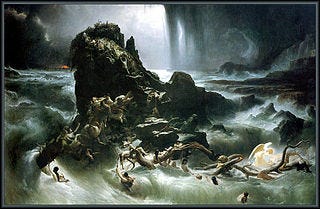
In a few passages of holy Scripture, we read that God regrets having done something. Regret, according to Thomas, is a certain sadness for something previously done by oneself. Thus, the reading of these passages is that God feels sorry for having done something evil–as e.g., when he is said to regret that he made the men who have wrought such destruction upon the earth (Gen. 6).

Today, many people take these sayings literally–or, to speak better, they understand them as somehow speaking properly, positing something in God. However, because God’s works are perfect (Deut. 32:4), no divine work can be regretted by God. This is why we instead read that God rather “treasures all which are, and despises nothing which he made” (Wisd. 11:24). Accordingly, no matter that holy Scripture says that God regrets, in reality he nowise does.
This leaves us with two options in handling these passages. The first option would be that these sayings, which admittedly are quite few, are false–and obviously some have held this position. But for the rest of us, the second option is that these sayings were just metaphors and need to be interpreted. Taking this latter line, how then must we interpret such sayings in holy Scripture?
STEP 1: LOOK FOR THE WORK
Initially, the fathers can guide us on interpreting divine passions generally speaking. They almost all agree that whenever we confront “God being impassioned with X” sayings in holy Scripture (where X = some passion), our first and most frequent interpretation is going to be passion put for work: i.e., the divine passion which was uttered by the prophet was only put in place of some creaturely state of affairs or happening–such a happening being considered as a divine work. Thus e.g., God being angered must be interpreted only as e.g., someone suffering pain as due punishment for his sin.
This pattern of interpreting is so universal among the fathers that it carries over into the medievals as well. There, we find the scholastic “rule of thumb,” divine passions are said non secundum affectum, sed secundum effectum. Hence e.g., Anselm in his Proslogion c 8 says that God sympathizing with our pain must not be interpreted as if it posited something in divine will, but only as positing something among us creatures, namely a divine work: e.g., our being saved, our being spared, etc.
Following this and applying it to divine regret, we can conclude that whenever we confront a passage saying that God regrets having done X, we are going to need to identify what creaturely happening is in view, broadly speaking.
STEP 2: LOOK FOR A CERTAIN WORK
Continuing and more precisely, the fathers also guide us as to what sort of creaturely happening we ought to look out for, in order to interpret divine passions. Namely, even before we ever get to God and holy Scripture, we need to determine what creaturely works are unique to the passion in question (or to such an impassioned man): i.e., what works (at least) tend to arise from this principle of man’s being. These creaturely works are going to be similar to the actual divine work which we hope to locate; and thus if we identify the former beforehand, we will be prepared to find the divine work and so actually interpret the metaphor. Hence e.g., among (creaturely) works which are unique to the passion anger, is punishing someone for an offense against oneself. Accordingly, when it comes to anger of God, we are to be on the lookout for concrete divine punishments for transgressions of divine law.
What then when it comes to regret? The certain works which are unique to a regretful man are those greatly differing from the course of his former works. This is because everyone who experiences regret first adjusts his course, and then afterward e.g., makes amends. So much is this so, that whenever any remarkable change occurs in the course of someone’s works, we are inclined to suspect that he must have regretted his former life–even if this isn’t true and the change, say, happened for a different reason.
In line with this, we can conclude that the passages of holy Scripture wherein God is said to regret, have put this passion for some remarkable change in the course of divine providence–either something falling away which was before, or something arising which was not. We might call this a great turnabout or upheaval among creatures, and strong examples would be the destruction of mankind, or the deposition of Saul. Unsurprisingly, from both of these the prophets say God regrets (Genesis 6:6–7; 1 Sam. 15:11), although in reality he nowise does.

The fathers really are unanimous here in giving this interpretation of divine regret. Augustine is a good example here:
“Usually we do not easily change something begun and shift to another except by regretting. Accordingly, although divine providence is seen (by those looking with a steady mind) to administer all realities by a most certain order, nevertheless adjusting all the way down to humble human understanding, those realities which began to be but did not continue as we expected them to have continued are said to have been removed through (so to speak) regret of God.”
In actual fact, all realities have been ordered most certainly, and the course of divine providence–with all its ebbs and flows–is most sure. And those who are wise know well that never is it that something is done, but then God “thinks better of it” so that something contrary arises. God does not tear down disappointed with what he built. The destruction which Genesis 6 reports is not as if God didn’t like his house, demolished it back to timbers, and started fresh–even though the earth really is reduced to its former foundations and built up newly again, and the cause of this is explicitly assigned in verse 7 as “because God regretted that he made man.” This assigned cause was mere metaphor which the prophet deployed to adjust to everyday persons and speak to their level. Hence he feigns that God regretted what he did. This of course has grounds upon the fact that the realities begun did not continue as we expected them to; and it is fitting because “usually we ourselves do not easily change something begun and shift to another except by regretting.”

Thomas, a good representative scholastic, follows suit. Handling Genesis 6:7, and then summarily all passages of this sort, he says:
“This word of the Lord, [namely, ‘that I regret’ in Genesis 6,] is to be understood metaphorically according to our similitude, because when we regret, we destroy what we made (although this can be without change of will, because even some man, without change of will, sometimes wills to make something when he simultaneously intends to destroy it later). So then God is said to regret, according to similitude of work, insofar as man whom he made God through the flood erased from the face of the earth.”
“God sometimes is said to be regretful, insofar as he according to the eternal and immutable order of his providence makes what he earlier destroyed, or destroys what he earlier made–just as we also, being moved by regret, are found to do.”
Thomas thus supplies the same interpretation as Augustine–although he uses a different explanation of the fittingness of this metaphor. He highlights that when this seismic event occurs, its relationship to God is akin to the relationship of a course-correction to a regretful man. Thus, when the prophet recounts this event, he says that it happened because God regretted–this, however, only “metaphorically according to our similitude”: i.e, according to the similarity of our relationship to our course-correction, to this event’s relationship to God.
Thomas adds one thing beyond Augustine. He reminds that although usually our own course-corrections arise from regret, nevertheless this is not always so. Suppose a man originally intended to build a house whose later destruction by another he simultaneously was intending to permit. In this case, its subsequent destruction appears to arise from some regret in him, although it nowise has done so. If someone were to speak of this and say that this destruction happened from the man’s regret, then either he would be speaking falsely, or merely metaphorically for purposes his own. For Thomas, something similar has occurred in the case of God.
Spot on; “… because God’s works are perfect (Deut. 32:4), no divine work can be regretted by God.” 😊